Sunday, August 30, 2009
The $30,000 Bequest and Other Stories

**** The $30,000 Bequest and Other Stories by Mark Twain. General fiction.
This is one of the free classics I got with my e-reader. And since it's a classic, and on my e-reader, I read it in bits and pieces over a long period of time. (My e-reader stays in my purse, for those times when I'm out somewhere and waiting, like at the dentist or something.)
I'd originally intended to comment on each story in the anthology, but there are a lot of them, and I didn't take notes, so it's been a very long time since I read the first ones. So just some general comments instead.
I'm not a short story reader, any more than I'm a poetry reader. Something about the forms just doesn't appeal to me. But Mark Twain made a difference. His humor and insight made most of the stories entertaining for me. Like the story in the title--how a $30,000 bequest changed people's lives--and not in the ways you (or they) would have expected. Or the stories about Adam and Eve from each of their points of view. Very funny, and human nature hasn't changed all that much since Twain wrote these.
Some of the stories were too dated for me to truly enjoy them--like "Post-Mortem Poetry", since we don't have similar obituaries now. But a little imagination kept them from being incomprehensible, and even gave a bit of insight into the time period.
Categories: Books, 4stars, GeneralFiction
Labels: 4 stars, books, GeneralFiction


Tuesday, January 27, 2009
The Guernsey Literary and Potato Peel Pie Society

***½ The Guernsey Literary and Potato Peel Pie Society by Mary Ann Shaffer and Annie Barrows. General fiction.
This was the latest selection for our neighborhood book club. Again, it served the purpose of getting me to read something I normally wouldn't read, and I had a wonderful time at the book club meeting, despite feeling just miserable (I had a sinus pressure headache from a change in the weather, a kink in my lower back, and I had bloating and indigestion from PMS--*rolling my eyes at the great timing*).
The Guernsey Literary and Potato Peel Pie Society is a story, written in epistolary style, about the island of Guernsey shortly after the end of WWII. Author Juliet Ashton is at loose ends, casting about for a subject for a new novel now that her stint as a humorous wartime columnist is over. A chance letter from Dawsey Adams, who'd purchased a used book formerly belonging to Juliet, sparks a series of letters to and from Juliet and the members of the Guernsey Literary and Potato Peel Pie Society, and results in friendships and the subject of Juliet's next book.
Through the letters, you get an interesting picture of the place and time. The technique makes for an almost surreal portrait--the reader is removed from the action both because it takes place in the past and because it's being related not directly to the reader, but to a third party. As a result, the horrors of war and the occupation feel on a par with everyday postwar life. Which was likely intentional--the war and the occupation were their everyday life for some time.
And for me, that was the most engaging part of the story--the setting and the background. The present story of the book--Juliet's love life and her relationships with her old friends back in England and her new friends in Guernsey--was more just a framework within which to tell the story of wartime Guernsey.
Perhaps this is a case of being jaded by reading so much, but I wasn't nearly as enthralled with the book as others were. It's a sweet little story--it imparts a historical lesson, and Juliet discovers a new direction for her life--but there's not much to it. Conflict, I think, is what I missed. In fact, a couple of my fellow book club members remarked that the one small bit of conflict (in the second half of the book, so I won't spoil it here) seemed to come out of nowhere, and I agree. Regardless, it didn't provide enough oomph to carry the book.
In addition, I didn't really feel there was much depth to any of the characters. Juliet was the one we knew best, and all I can really say for certain about her is that she has enough self-preservation to turn down would-be fiances who expect her to give up her identity.
Still, as I said, it's a sweet little story, it fits a certain niche very well. Even my book club edition came with a ribbon book mark, but I'd think this would be best in a slightly-smaller-than-usual hardcover with the ribbon book mark and no dust jacket--a book you'd tuck into a gift basket for someone who's ill. Even without a special edition, this is one book I'd definitely feel good about giving as a gift, particularly to someone who wouldn't have the time or energy to tackle heavy reading.
Categories: Books, 3.5stars, GeneralFiction
Labels: 3.5 stars, books, GeneralFiction
Monday, January 05, 2009
In the Lake of the Woods

****½ In the Lake of the Woods by Tim O'Brien. General fiction.
I thought I'd gotten this book from Dagny, who met the author when she won an essay contest about The Things They Carried, but she says no. I'm not sure why I bought it, then. I'll probably be passing my copy on to her when she leaves, so I figured I'd better write about it while I still have the book here to refer to.
In the Lake of the Woods is about the disappearance of Kathy Wade. Her husband John was a candidate for the U.S. Senate, and has just lost by a landslide after damaging revelations of his actions in the Vietnam war. They've gone to a lakeside cottage to avoid publicity, and after a disturbing night, Kathy disappears.
The story is told in various parts by a narrator who's trying to figure out what happened to Kathy Wade: what's currently happening, flashbacks of John in Vietnam, evidence from various sources, and hypotheses of what might have happened. We know from the start that there is no answer to the mystery, and that is periodically reinforced, so despite how frustrating it is to read a mystery with no solution, I knew what to expect (unlike, apparently, several reviewers *rolling my eyes* --maybe they didn't believe it when then narrator kept saying that nobody knew what happened to Kathy Wade?), and could enjoy speculating which of the hypotheses was true.
One little itty bitty thing I have to get off my chest: why is every single fictional soldier in Charlie Company? Why not Bravo company or Alpha, Delta, or Echo? That's not a criticism of the book, by the way, just of literary conventions that bug me.
While I enjoyed the mental exercise of putting together a complete picture of who John Wade was and what had happened from all the different segments, I never felt truly emotionally engaged. I didn't really care what happened to Kathy Wade. Which, in retrospect, probably made me able to enjoy the book more. If I'd been emotionally invested in the outcome of the mystery, the open-ended-ness of the story would have left me much more frustrated rather than intrigued.
Something that In the Lake of the Woods definitely succeeded at was in making me think--and not just while I was reading it. For example, I'd been thinking that the reader never really got to know Kathy Wade, and only saw superficial opinions from acquaintances, and the biased and slanted opinions of her sister and husband. Then it occurred to me that that's the only way we could have known her, which led me to think about the nature of knowing someone in general.
Probably the biggest issue the book made me contemplate was one a reviewer trashed it for: whether someone can go on to live a normal, even successful life, after being involved in atrocities like the one John Wade participated in during the Vietnam war. The reviewer said it's unequivocally impossible for anyone ever to put that behind them. I think the reviewer is seriously naive and doesn't know human nature very well. Humans have a vast capability for adaptation and self-delusion, and I think that was amply demonstrated in the writing.
In the same vein, it's interesting to read between the lines of John's flashbacks and the comments from others to guess what's truth, what's lies, and what's self-delusion--not just for the mystery of Kathy's disappearance, but for his experiences during the war and for his relationship with his wife.
Whatever prompted me to buy this, I'm glad I did, and I'll keep an eye out for other O'Brien books.
Categories: Books, 4.5stars, GeneralFiction
Labels: 4.5 stars, books, GeneralFiction
Friday, November 14, 2008
Fall Reading Challenge
The reading challenge for fall is to read a book that won a Costa award. You can find a list at http://www.costabookawards.com/awards/previous_winners.aspx.
I chose:

***** The Curious Incident of the Dog in the Night-Time by Mark Haddon. General fiction.
Well, this was a nice surprise. A bestseller that I actually loved.
Christopher John Francis Boone is an autistic boy. The story opens when the next-door neighbor's dog was killed with a garden fork and Christopher discovers it, and decides to solve the mystery, because he likes mysteries. They're puzzles, and he's good at puzzles, just like he's good at math, because he likes patterns.
In the course of his quest, we learn a lot about his life, and about the way he thinks, which in turn illuminates quite a bit about humanity in general. For example, Christopher has trouble with people because they're unpredictable, because he can't interpret subtle emotional and behavioral clues like facial expressions--pointing out, of course, how much the rest of us depend on those things.
Christopher's internal life is so clearly written that it's easy to understand how and why he behaves as he does... and easy to put myself in his shoes. It wouldn't even take that much--just a slight skewing of the mind.
But The Curious Incident of the Dog in the Night-Time is not just a description of autism. There's also the story of a difficult and dramatic period in Christopher's life, precipitated by the killing of the dog. Since he's an unreliable narrator, that gives the story an added dimension, as the reader has to interpret how Christopher's observations would appear to someone else.
It's emotional and enlightening, but mostly I just found it fascinating to spend time in Christopher's head. That aspect reminded me of Tod Goldberg's Living Dead Girl, Crista Jean Chappell's Total Constant Order, and Mil Millington's Love and Other Near-Death Experiences. Maybe it's a remnant of when I was a teenager and wanted to become a psychiatrist, or maybe it's just feeling an affinity because of the skewed places in my own mind, but whatever the reason, I love reading about characters who don't think the same way as everyone else--or at least the way we assume everyone else thinks.
To participate in the reading challenge, leave a comment here or post on your blog to let us know what you read, how you liked it, and whether you'll be inclined to read a book from this category again.
Categories: ReadingChallenge, Books, 5stars, GeneralFiction
I chose:

***** The Curious Incident of the Dog in the Night-Time by Mark Haddon. General fiction.
Well, this was a nice surprise. A bestseller that I actually loved.
Christopher John Francis Boone is an autistic boy. The story opens when the next-door neighbor's dog was killed with a garden fork and Christopher discovers it, and decides to solve the mystery, because he likes mysteries. They're puzzles, and he's good at puzzles, just like he's good at math, because he likes patterns.
In the course of his quest, we learn a lot about his life, and about the way he thinks, which in turn illuminates quite a bit about humanity in general. For example, Christopher has trouble with people because they're unpredictable, because he can't interpret subtle emotional and behavioral clues like facial expressions--pointing out, of course, how much the rest of us depend on those things.
Christopher's internal life is so clearly written that it's easy to understand how and why he behaves as he does... and easy to put myself in his shoes. It wouldn't even take that much--just a slight skewing of the mind.
But The Curious Incident of the Dog in the Night-Time is not just a description of autism. There's also the story of a difficult and dramatic period in Christopher's life, precipitated by the killing of the dog. Since he's an unreliable narrator, that gives the story an added dimension, as the reader has to interpret how Christopher's observations would appear to someone else.
It's emotional and enlightening, but mostly I just found it fascinating to spend time in Christopher's head. That aspect reminded me of Tod Goldberg's Living Dead Girl, Crista Jean Chappell's Total Constant Order, and Mil Millington's Love and Other Near-Death Experiences. Maybe it's a remnant of when I was a teenager and wanted to become a psychiatrist, or maybe it's just feeling an affinity because of the skewed places in my own mind, but whatever the reason, I love reading about characters who don't think the same way as everyone else--or at least the way we assume everyone else thinks.
To participate in the reading challenge, leave a comment here or post on your blog to let us know what you read, how you liked it, and whether you'll be inclined to read a book from this category again.
Categories: ReadingChallenge, Books, 5stars, GeneralFiction
Labels: 5 stars, books, GeneralFiction, reading challenge
Wednesday, November 12, 2008
A Thousand Splendid Suns

*** A Thousand Splendid Suns by Khaled Hosseini. General fiction.
This is the second book for our neighborhood book club, and this time I've finished it in plenty of time (our book club will meet next Wednesday). I'd really enjoyed The Kite Runner, but I wouldn't have picked this one up if it hadn't been for the book club. Call me shallow, but I read the paper and listen to the news--I have a good idea of all the terrible things that are going on in the world. I prefer my leisure reading to be less depressing.
And A Thousand Splendid Suns was depressing. When I went to bed last night, I was about halfway through the book. I'd intended to read for a half hour and then turn out the light, but it just kept getting more and more depressing, and sleep was out of the question until I finished it... and even then, I needed a little... er... help... from Carl to wind down enough to sleep.
Mariam is the illegitimate daughter of a wealthy man, and for her first 15 years, she lived a secluded life in a hut with her mother.
Laila is the daughter and youngest child of a former schoolteacher, who lived in the city in relative comfort for her first 14 years.
Both women loved their fathers and had difficult relationships with their mothers. Mariam's mother was a bitter epileptic; Laila's was depressed and focused on her older sons who'd gone off to war. They both ended up married to the same abusive man. But I'm getting ahead of myself.
The first part of the book focuses on Mariam's life until shortly after she's given in marriage to the much-older shoemaker, Rasheed. Then it abruptly changes to Laila's life, and we hear nothing more about Mariam until the third part when the two of them are together. I'm not sure what a better way of handling it would have been, but this disjointed style kept me from really bonding with either of the main characters. Sympathizing, yes; but I wasn't really involved with either of them.
Which may have been just as well, because Mariam's life was just so unremittingly depressing. She did idolize her father, but underneath her excitement was the unmistakable evidence that she was denied everything his legitimate children took for granted, everything except an hour or two of his time every week.
Laila's life was less bleak, at least at first. True, her mother was neglectful and openly preferred her absent sons to her daughter, and she sneered and disparaged her husband, but Laila and her father had each other, and Laila also had her best friend Tariq.
Once Mariam and Laila's lives intersected, things just kept getting worse and worse for both of them, with even the few bright spots provided by the children overshadowed by negative events and the difficulty of caring for them.
Kudos again to Hosseini for providing what felt like--from this outsider's perspective, anyway--a fairly balanced view of the position of women under Afghanistan's various governments from 1964 to the present. It was definitely interesting reading about places I'd previously only heard of from the news. But while the larger issues felt well-balanced, the more personal ones didn't. Rasheed in particular suffered from being a character type. Maybe that was intentional, because we're seeing him from the women's perspective, and maybe that's how they saw him, but I'd have liked to know more about him than that he had a god-complex. Everyone is the hero of his or her own story. I'd have liked to see a little of how Rasheed saw himself--more than as his wives' lord and master. Even the brief descriptions of his previous wife and child aren't all that enlightening.
Then there's the ending. I'm not going to give it away, but the book first gets incredibly bleak, then has a sunny, happy, hopeful ending, that didn't seem to fit the story at all. Not that I wanted an "everyone dies, life sucks" ending, but perhaps a little more of what the entire book needed: balance.
Again, no, I'm not hiding my head in the sand or denying that life is incredibly bleak, sad, depressing, and dangerous for far too many people in the world. I wouldn't find it realistic for Mariam, or even Laila, to start a women's revolution or even succeed in forcing their husband to treat them better. But one thing I tend to expect when I read more serious books is to gain some insight into humanity, and I didn't get any more insight from A Thousand Splendid Suns than I have from any number of dry news reports about the plight of women in Afghanistan. I didn't learn how women would cope emotionally, nor did I learn about the men's motivations in subjugating them.
A-ha. I knew if I kept typing, I'd find my point sooner or later. Neither of the main characters really changed in the course of the book. Oh, Mariam did find some happiness with Laila and the children, but it didn't change her. And Laila, depsite all she went through, didn't change at all--she altered her behavior to deal with changing circumstances, but once circumstances improved, she was the same person she was before. And that would be forgivable if I'd gained some insight from their stories, but I didn't.
Mariam and Laila ended the book as the same people they were when they started it, and so did I.
Categories: Books, 3stars, GeneralFiction
Labels: 3 stars, books, GeneralFiction
Monday, October 27, 2008
The Story of Edgar Sawtelle

***½ The Story of Edgar Sawtelle by David Wroblewski. General fiction.
Whew. I finally finished this. If you read my weekend update, you'll know that this was the first book for our neighborhood book club, and I hadn't finished it by the time we met on Wednesday. I needed a break from it, so I read No Escape when it arrived in the mail on Friday, then went back to this.
Edgar Sawtelle is a mute 14-year-old boy (for the bulk of the story, anyway--it begins before his birth). He lives with his parents on a farm where they breed and train Sawtelle dogs. The dogs are chosen for temperament rather than appearance or other physical traits, following Edgar's father and grandfather's theories of creating the next evolution of dogs.
The story picks up when Edgar's uncle Claude arrives, and his father gives him a job on the farm and a place to live. There's tension between them, and eventually, Edgar's father dies mysteriously. One thing leads to another, and then Edgar is on the run with three dogs.
Much of the book is descriptions of dog training and Edgar's efforts to communicate. Once Edgar's father dies, that expands to include a suspense element. It's very atmospheric, and for a while, I'd really sink into the writing, which has an ominous, dream-like feel to it. I'd have to put it down periodically, though, because it got to be too much--kind of like eating marzipan, it's rich but you can't make a meal of it.
The Story of Edgar Sawtelle did make a good book club book, because there was a lot there to discuss--a lot of imagery, foreshadowing, and metaphor. And there were the parallels to Hamlet, which felt forced at the end, but were still good discussion fodder. It will probably thrill English Lit professors for years.
For recreational reading, though, I wouldn't have chosen it, and not just because it has a sad ending (oh, come on--that's not a spoiler: the professional reviews all cite Hamlet, and if that's not enough, it's an Oprah book. Oprah doesn't pick books with happy endings.).
One thing we did discuss at the book club that really pinpointed my so-so reaction was that none of us ever cried or even got a lump in our throats while reading even the saddest scenes. That, I think, was the result of the remote, dreamlike writing style. The reader is removed from the characters, so even though you can think "oh, that's sad," you don't really feel it. Obviously, it's not just me--none of the 10 other women in the book club felt it either, and we all have vastly different reading styles.
And then there were the threads that were either dropped or contradicted, mostly, it seemed, in order to squeeze in those Hamlet parallels. There were a lot of details that got carried through the book and made sense later on, but there were just as many that just fell flat. Chief among them, I thought, was the attempt to breed dogs you could train to make choices. For the amount of time spent on it during the book, it should have played a much more important part in the ending.
Speaking of the ending--the fourth-to-last chapter should have been the end of the book. It really should have. It made an excellent ending. Instead, the book dragged on for three more chapters, trying to wring as much bleakness out of the subject as possible, I suppose. Or a writing style choice, thinking that we had to know what happened after the end. It's okay to leave a few things unsaid. And as a matter of fact, except for one major development which could have fit easily into that fourth-to-last chapter, nothing was really solved in those last chapters. They were just reminding the readers that we'll have to figure out for ourselves what happens to certain characters. We could have figured that out without the reminders.
As for specific details--Claude had obviously been in prison (it's alluded to when he first arrives), yet sheriff Glen trusts him implicitly, without question? Granted, Claude can be very charming when he wants to be, but that didn't make a lot of sense to me. And what was the point of Henry? We didn't need to know his entire life story, but I was left with the feeling that I wanted either more or less of him in the book. The little girl who had a curious insight about Edgar's muteness--I'd have expected to see a little more of her, or for her insight to have some import. And Ida Paine, the old lady with "the sight"--she was definitely not utilized as much as she could have been.
I suppose I'm glad I read it. It does have some beautiful language, and the dreamlike quality of the writing was nice to sink into occasionally. I wouldn't read it again, nor would I seek out anything else by this author--though since it took him ten years to write this book, I suspect that's not going to be an issue.
Categories: Books, 3.5stars, GeneralFiction
Labels: 3.5 stars, books, GeneralFiction
Monday, September 15, 2008
Instructions for Living Someone Else's Life

****½ Instructions for Living Someone Else's Life by Mil Millington. General fiction.
Thank goodness for author newsletters. If I weren't on Mil Millington's newsletter mailing list, I'd never have known this book was out. To any authors wondering whether or not to set up a newsletter, here's my vote for "please do!"
And thank goodness for Amazon.de. Instructions for Living Someone Else's Life isn't out in the U.S. yet (which is why the link in the header is to Amazon.de). Given the exchange rate (though it's been soaring upward lately and is currently higher than it's been in about 3 years), it's a little more expensive, but I got the book in 3 days, and shipping on books is free even if you only buy one, which is very cool. Here's the Amazon.ca link for anyone in North America who's thinking of buying it: Instructions for Living Someone Else's Life.
As the book opens, 25-year-old Chris is out with his friends, celebrating his intention to quit his job in advertising which he despises but which he's, perversely, very good at, and anticipating a fight with his girlfriend because he didn't tell her about this ahead of time.
The next thing he knows, he's waking up in bed with a strange woman. Hilarity and hijinks ensue and it finally becomes clear that it's now 2006--18 years later, that strange woman is his wife, and nothing is the same... except that he's apparently still at the same job.
The whole story is a fabulous metaphor for middle age--if you are or have been middle-aged, you'll recognize the feeling; if you're not yet, you can imagine and relate to the horror Chris feels at being 25 and finding himself stuck in a 43-year-old body and a 43-year-old life.
As with Millington's previous books (Things My Girlfriend and I Have Argued About (#4), A Certain Chemistry, and Love and Other Near-Death Experiences), the laughs are non-stop, because it's all so very true. His characters are ruthlessly real, and I dare you not to recognize bits of yourself in them, even while you're wincing and denying it.
I did have a quibble--which is why this only got 4.5 stars instead of the usual 5 for Millington's books: the story about Chris's old boss came from out of nowhere and went nowhere--it didn't connect to anything else in the story. Same with old friend Nick's infidelity. I got the impression that connecting bits got edited out at some point in the process.
Otherwise, I absolutely loved this book. The myriad changes Chris discovered and tried to come to terms with were familiar, but the way they were presented made me look at them in a new way, and laugh about them. Everything from cell phones (a Star Trek device?) to fashion (40-somethings wearing jeans??) to television (mean-spirited reality shows) to society (it's really okay to say you don't care about politics?), and of course the physical changes--the redistribution of hair, the addition of pounds, how waking up with a hangover in your 20s feels like waking up on a normal morning in your 40s.... Most pointed is how nothing really turned out the way you expected.
I wholeheartedly recommend this book for anyone who is, has been, or hopes to eventually become middle-aged.
Categories: Books, 4.5stars, GeneralFiction
Labels: 4.5 stars, books, GeneralFiction
Monday, May 26, 2008
The Kite Runner

****½ The Kite Runner by Khaled Hosseini. General fiction.
I bought this from Zooba (now BOMC2) as part of my effort to expand my reading horizons--I tend to stay far, far away from "bestsellers," especially books that are promoted as being "bestsellers" even before they hit the shelves. But I realized that this, too, is a prejudice, so I started putting a few in my queue.
Despite all the hype, all I knew about The Kite Runner prior to reading it was that it was about Afghanistan, and that people either loved or hated it because of that.
It is indeed set in Afghanistan, but it's about Amir, the son of a wealthy businessman, and his friend Hassan, the son of Amir's father's servant. It's about childhood, and the limitations of friendship when confronted with class differences and competition for a distant parent's love. It's about growing up, and coming to terms with childhood injustices, both those given and received. The setting of Afghanistan definitely contributes to the plot, but it's not, in itself, what the book is about.
The Kite Runner is a powerful, uncomfortable story. I heartily disliked Amir for quite a while until I recognized some of my own petty childhood cruelties, both received and perpetrated, and realized that he wasn't exceptionally cruel or self-centered--he was just a child.
I doubt I'll read this again, but I'm very glad I read it.
Categories: Books, 4.5stars, GeneralFiction
Labels: 4.5 stars, books, GeneralFiction
Thursday, April 03, 2008
Citizen Vince

****½ Citizen Vince by Jess Walter. General fiction.
Someone recommended this, I'm not sure who. It's obviously not my usual reading material, and I love expanding my reading horizons, so I really appreciate the recommendation--if it was you, thanks!
Vince Camden works in a donut shop, a job he got when he moved to Spokane, Washington as part of the witness protection program. He also plays a lot of poker, and runs a low-level but fairly successful credit card scam. He's getting along, just kind of existing. Then two things happen that change his outlook and his life: he receives a voter registration card in the mail, and a hitman from back east shows up in town.
A felon from the time he was a teen, Vince had never been able to vote. But now with a new identity and a new start, he can. And Vince takes this privilege and responsibility very seriously. It's 1980, the Reagan/Carter election, and the question of whom to vote for consumes him. Actually, a more timely theme now than when Citizen Vince came out, back in 2005.
Vince is worried that the hitman from back east has come looking for him, and decides to set things straight, and pay his debts to cancel the contract on his life. In the meantime, the hitman is muscling in on his credit card scam, and Vince tries to protect his partners as well as himself.
Citizen Vince is billed as a redemption story, and it is that, but mostly it's a character study. It took me a while to warm up to Vince, but even when I didn't like him, I found him interesting.
The slightly historical setting was interesting as well--though it was rather painful to realize that events I remembered watching on TV in the East Quad dorm happened *gulp* 28 years ago.
Categories: Books, 4.5stars, GeneralFiction
Labels: 4.5 stars, books, GeneralFiction
Saturday, February 23, 2008
Have You Seen Me?

*** Have You Seen Me? by Laura Denham. General fiction.
Juliet has lived in a downward spiral, from sexual abuse through becoming a stripper, then a prostitute. Then when she tries to pull herself up by joining the sort-of commune that made such a change in her friend Mary, it turns out... well, that's a spoiler, so I won't tell you.
This is a rather surreal book. It's written in first person, but in an extremely matter-of-fact way, so rather than being immersed in the character's emotions, as you'd expect, you get no emotion whatsoever. Juliet describes sex and the weather with equal passion (none), and gives me the impression of a damaged, surly teenager daring the reader to be shocked, or to care.
And that was probably the point--that Juliet was psychologically damaged, and in real life, she would have a flat affect. It just doesn't make for a very engaging book.
I did find it interesting, in a rather detached way, and the ending was ironic, but ultimately, it just wasn't my cup of tea.
Categories: Books, 3stars, GeneralFiction
Labels: 3 stars, books, GeneralFiction
Wednesday, January 16, 2008
Veil of Roses

***** Veil of Roses by Laura Fitzgerald. Women's fiction.
27-year-old Tamila Soroush was a school teacher in Iran, but she's been increasingly chafing under the restrictions. So her parents give her the gift of a trip to the United States to visit her sister Maryam, whom she hasn't seen in 15 years.
Maryam had married an Iranian with American citizenship, surgeon Ardishir, and everyone's hope is that Tami will do the same. Her visa is good for 3 months.
While Maryam arranges dates for Tami with eligible men, Tami wants to experience America. She attends an ESL (English as a Second Language) class with other immigrants and makes friends there, and she visits a Starbucks on her way to class, where she meets and becomes friends with Ike. All the while, she's taking photographs of the freedoms she sees, little things that are taken for granted but wouldn't have been possible for her in Iran.
The sisters Maryam and Tami and very interesting together. Maryam lives, dresses, and cooks much like she would in Iran, and yet she would have Tami marry almost anyone who would have her simply so she can stay in the U.S. Tami, on the other hand, is determined to try new foods, and be more American (there's a funny and poignant thread about shoes), and yet she'd rather go back to Iran than marry the nutcase Maryam had picked out for her. Maryam's husband Ardishir is a strong ally and a voice of reason for Tami.
The ESL class was also very interesting, showing the reactions of people from various cultures to America. Eva, the young German wife of an American soldier, was especially realistic--I'm sure I've met her before.
And of course there's Ike, who's fascinated by the exotic young woman who becomes his friend.
Veil of Roses is a wonderful love story, and a fascinating portrait of a woman coming from a restrictive society into a permissive one. The things that surprised or confused Tami weren't the big things that I'd expected--they were the little things, and as such, they rang very true--Tami had been prepared for the big things--she hadn't been living in a vacuum.
Which is something that I really appreciated. I admit being mildly apprehensive when I picked this book up to read for the Cherry Forums Book Club (discussion archived here)--I was expecting a more black-and-white story: Iran = bad, U.S. = good. It's not that story. I found a balanced view of both cultures, and Tami admits she could be contented with a life in Iran, but she wants more.
Besides being an entertaining and emotional story, Veil of Roses was very thought-provoking, about different cultures and prejudices and freedom, love, and adaptation.
Categories: Books, 5stars, GeneralFiction
Labels: 5 stars, books, GeneralFiction
Friday, November 02, 2007
Fall Reading Challenge
Whoops. I see I need to update the reading challenge in my sidebar.
Banned Book Week is the last week in September. With that in mind, read a Banned Book.
I chose:

****½ Beloved by Toni Morrison. General fiction.
I have to admit, I approached this novel with quite a bit of trepidation. It was an Oprah's book club pick, which generally means depressing, and I tend to be leery of "highly acclaimed" books. Maybe a bit of reverse snobbishness. But I've been making a point lately of ignoring my knee-jerk reactions and trying to check things out before I judge them. And too many of the other books on the banned book list I'd consulted were either children's books (nothing against children's books, but I didn't feel like reading one), books I'd read already, or ones I had no interest in.
If you haven't heard anything about it, Beloved is the story of Sethe and her daughter Denver, who live alone with a ghost now that her mother-in-law has died and her two sons have left home. A man from Sethe's past shows up, Paul D., and then a young woman, Beloved, who becomes ever more demanding.
Through a series of flashbacks and memories, we get the picture of Sethe's life, and how and why it culminated in her killing one of her children and attempting to kill the others. I'd been forewarned about that (Dagny had to read this for a class), so it wasn't as much of a shock as it might have been.
Beloved is a powerful novel. I can't really express it any other way. It provides an unvarnished look at a period in history that would be more comfortable to forget. But if that were all it was, I wouldn't have liked it so much. I'm not one to hide my head in the sand, but I don't see the point of dwelling on the horrors people inflict on each other, either. I like to know and then move on.
It's also a story of community, and how people react as groups. Sethe was rejected by her community, not as much because she'd killed her child, but because she was too independent. It's an interesting concept, and one that applies very much to me as well--like Sethe, I find it shameful to ask for help, preferring to do without than to reach out. So the story hit me on that level as well.
But for me, mostly, it was a story of guilt, and how Sethe's guilt manifested itself (literally), and how she needed to accept help to forgive herself. And that's what really made the story for me.
I doubt I'll re-read this, at least not for a long time, but I'm very glad I did. I do intend to check out more of Toni Morrison's work, but if it's as intense as this, it'll have to sit in my TBR pile a while until I need a sink-your-teeth-into read. Any suggestions/recommendations?
...more
Categories: ReadingChallenge, Books, 4.5stars, GeneralFiction
Banned Book Week is the last week in September. With that in mind, read a Banned Book.
I chose:

****½ Beloved by Toni Morrison. General fiction.
I have to admit, I approached this novel with quite a bit of trepidation. It was an Oprah's book club pick, which generally means depressing, and I tend to be leery of "highly acclaimed" books. Maybe a bit of reverse snobbishness. But I've been making a point lately of ignoring my knee-jerk reactions and trying to check things out before I judge them. And too many of the other books on the banned book list I'd consulted were either children's books (nothing against children's books, but I didn't feel like reading one), books I'd read already, or ones I had no interest in.
If you haven't heard anything about it, Beloved is the story of Sethe and her daughter Denver, who live alone with a ghost now that her mother-in-law has died and her two sons have left home. A man from Sethe's past shows up, Paul D., and then a young woman, Beloved, who becomes ever more demanding.
Through a series of flashbacks and memories, we get the picture of Sethe's life, and how and why it culminated in her killing one of her children and attempting to kill the others. I'd been forewarned about that (Dagny had to read this for a class), so it wasn't as much of a shock as it might have been.
Beloved is a powerful novel. I can't really express it any other way. It provides an unvarnished look at a period in history that would be more comfortable to forget. But if that were all it was, I wouldn't have liked it so much. I'm not one to hide my head in the sand, but I don't see the point of dwelling on the horrors people inflict on each other, either. I like to know and then move on.
It's also a story of community, and how people react as groups. Sethe was rejected by her community, not as much because she'd killed her child, but because she was too independent. It's an interesting concept, and one that applies very much to me as well--like Sethe, I find it shameful to ask for help, preferring to do without than to reach out. So the story hit me on that level as well.
But for me, mostly, it was a story of guilt, and how Sethe's guilt manifested itself (literally), and how she needed to accept help to forgive herself. And that's what really made the story for me.
I doubt I'll re-read this, at least not for a long time, but I'm very glad I did. I do intend to check out more of Toni Morrison's work, but if it's as intense as this, it'll have to sit in my TBR pile a while until I need a sink-your-teeth-into read. Any suggestions/recommendations?
...more
Categories: ReadingChallenge, Books, 4.5stars, GeneralFiction
Labels: 4.5 stars, books, GeneralFiction, reading challenge
Thursday, September 20, 2007
Love and Other Near-Death Experiences

***** Love and Other Near-Death Experiences by Mil Millington. General fiction.
First, a Public Service Announcement: Do not click on the author's name. Normally, on this blog, doing so will take you to the author's website. It does that here, as well, but Mil Millington's website is Things My Girlfriend and I Have Argued About. It will make you laugh aloud (so your boss will realize you're surfing the internet at work), and put you at risk of snorting coffee through your nose and/or spitting it all over your monitor and keyboard. If you click anyway, it's not my fault. You've been warned.
ETA: by the way, it appears that TMGAIHAA is currently unavailable, so you're safe for the time being. If you're determined to risk it, though, you can get most of the same content at Mil's Apology Homepage. It just takes a little more clicking.
Like Millington's previous two books, Things My Girlfriend and I Have Argued About (#4), and A Certain Chemistry, Love and Other Near-Death Experiences had me laughing aloud every other page, frequently laughing so hard I'd have tears running down my face and I'd feel compelled to quote funny bits aloud to whoever was handy at the time.
But that's where the similarity ends. If possible, I think this is even better than the first two, and I absolutely loved the first two.
Late-night disk jockey Rob Garland is losing it. Ever since... okay, it's not a spoiler because it's all right there on the cover, but since I make it a policy not to read the back covers of books because I want to get the full effect, it was a little bit of suspense you won't get if I tell. Still, if you're reading this about a book you haven't read yet, you'd likely read the back of the book anyway, right? Okay, then. I feel better now. On we go. Ever since returning some towels made him late for a lunch interview, thereby saving his life when a tanker truck crashes into the restaurant, killing everyone inside, he's been crippled by indecision: which decision was it that saved his life? Was it returning the towels? Or was it buying the towels in the first place? Or maybe it was whatever made him turn and see the towels in the shop window. Or something even more mundane. And what about the future? What if choosing black over blue ink sets in motion the events that will end up killing him? What if it's the blue ink that does it? How can he choose?
It finally gets to be too much for him one night, and instead of playing jazz, he blurts out the whole story on-air. Rather than losing his job, though, he becomes instantly popular, and his show turns into a freak-show talk show with Rob as the main attraction.
But this isn't a case of talking making things better, and his fiancee Jo finally tells him the wedding is off unless he gets his act together, and Rob goes off on a quest, accompanied by three people who also didn't die when they should have: a young American soldier who's appointed himself Rob's bodyguard, an acerbic and suicidal 40-year-old English teacher, and a gorgeous young Welsh Wiccan woman with warnings about a group trying to wight...er, right... the wrongs of unwarranted survival.
I've always loved the butterfly-effect concept anyway--the idea that some minuscule detail could have a huge effect, and the idea that this otherwise normal person is literally paralyzed by indecision is compelling. We get pretty thoroughly inside Rob's head, and it's fascinating how normal a place that is.
There's the mystery and suspense--is someone really after them, or is that just psychological, too? And the developing and changing relationships between the characters--love and friendship and romance. And the slightly askew way of viewing it all that marks Millington's writing and would make me snort tea out my nose if I didn't know better than to drink while reading his books.
Just a complete joy to read.
...more
Categories: Books, 5stars, GeneralFiction
Labels: 5 stars, books, GeneralFiction
Wednesday, May 09, 2007
East of Eden

***** East of Eden by John Steinbeck. General fiction.
Dagny sent this one to me, appalled that I'd never read it. I send her Evanovich, she sends me Steinbeck. If I were an astute kind of person, that might explain some things. Good thing I'm not astute. (I told you I would be doing this quote to death, didn't I?)
I've been putting off writing something about this, meaning that, although I've been reading the same book for over a week now (!! unheard-of!), I'm still behind. I think I'm a little intimidated because it's A Classic.
What the heck. The point is just to say if I liked the book and why or why not. Zillions of people have reviewed and analyzed and dissected this book, and there's really no reason for me to do that. Whew.
So, on the off chance that I'm not the only cultural illiterate out there, East of Eden is the story of the Salinas Valley of California, and about two families, the Hamiltons and the Trasks.
I had a little trouble following the connections between people at first, but it became clear later on. The Hamiltons are Steinbeck's family--in fact, he's in the second part of the story himself as a child, and my guess is they're there to make the story personal, and to contrast with the Trasks and provide a nudge to them once in a while.
Mostly, it's the story of two generations of brothers: Charles and Adam Trask, and Caleb and Aron Trask. Adam was his father's favorite, which caused a lot of problems between the brothers. He later marries and his wife gives birth to twins: Caleb and Aron, and the pattern threatens to repeat itself.
There's a bit of heavy-handed Cain and Abel imagery there, even down to the names, but the characters are so convincingly realistic that it never interfered with the story, and indeed was only apparent when I put the book down for a while. What I really enjoyed was the struggle between Caleb and Aron, trying not to repeat the pattern, and the realization that everything wasn't exactly as it seemed from the outside or on the surface.
...more
Categories: Books, 5stars, GeneralFiction
Labels: 5 stars, books, GeneralFiction
Friday, March 23, 2007
Living Dead Girl

*****+ Living Dead Girl by Tod Goldberg. General fiction.
This is the result of blog-hopping. I discovered Tod Goldberg's blog via SmartBitches, and got hooked on his writing there. It was much later that I decided I enjoyed his writing enough to take a chance on buying his books.
Paul Luden is a brilliant 32-year-old anthropologist. When he hears that his ex-wife Molly is missing, he and his 19-year-old girlfriend Ginny travel to her house to look for her.
Paul is also prone to depression, as was his ex-wife. They'd split up after the death of their daughter under some suspicious circumstances, but remained connected to each other. As it becomes more and more apparent that Molly didn't just walk away, it also becomes less and less clear that Paul had nothing to do with her disappearance.
Living Dead Girl is a mystery, and a fascinating one--I didn't really know until the end what happened and whodunit.
It's also the story of obsessive love, and a very compelling tale of a man who lives too much inside his own head--so much so that he doesn't always know what's real and what's not. His thoughts and emotions are so clear, so believable and understandable, that it was a little frightening--how easy it would be to let go of reality.
Either part of the story on its own would have been a wonderful, readable tale. Combined, it's exceptional.
...more
Categories: Books, 5+stars, GeneralFiction
Labels: 5+ stars, books, GeneralFiction
Monday, November 20, 2006
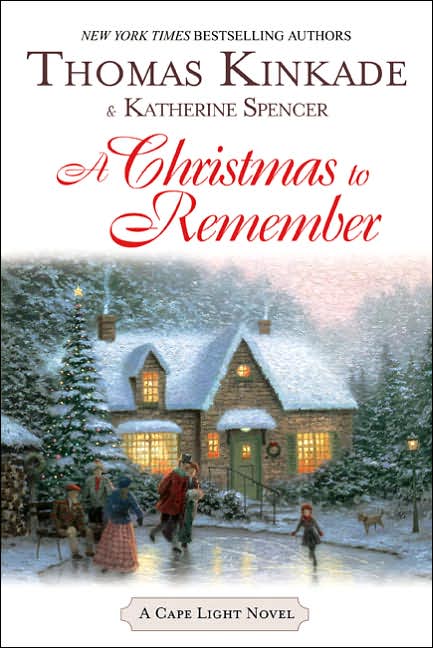
** A Christmas to Remember by Thomas Kinkade and Katherine Spencer. General fiction.
This is, I think, the 7th story set in the small fictional town of Cape Light. Sadly, I've read a previous one (#11), and familiarity didn't help.
The story goes between 3 different story threads: 1) elderly curmudgeon Lillian Warwick is injured in a fall (the flyleaf says she has pneumonia--she doesn't); 2) Lillian in her youth; and 3) nursing student Lucy Bates.
You'd think the three threads would intertwine--that Lucy would end up caring for Lillian at the hospital, and that things that happened in Lillian's youth would affect her present. They don't. At all. It's like three completely separate stories.
The only commonality between young Lillian and old Lillian is that I didn't like either one of them. Young Lillian was the type of young woman who's rude to men on principle. I despise that trait. And old Lillian was rude to everyone.
Lucy wasn't much better--she was a doormat. Her husband resents her spending time at her studies, especially when she has to work at the hospital, so he belittles her and does his best to undermine her confidence, refusing to help with the kids or the house. Lucy's reaction? To doubt herself and finally give up.
There were also a couple of annoying errors that stuck in my head. One was the nursing school. At one point, Lucy performs perfectly all day, but forgets to raise a bed rail. Her instructor tells her she gets an F for the day because of that. I don't buy that one mistake would merit a failing grade. I also don't buy that nursing students get letter grades for each day. Granted, my hospital experience is a couple of decades old, and it was a decade earlier than that that my mom went to nursing school, so it could very well be realistic--it just didn't feel like it.
The other one was really stupid. The hero of young Lillian's thread gets a Purple Heart. For valor. Um. No. Even non-military types know what Purple Hearts are, and they're not for valor. A quick click to Wikipedia would have fixed that.
Yeah, those were minor. The big problem is that the book was boring. Nothing really happened, there was no rhyme or reason to collecting those three threads in this book--it would have worked better if they'd been separated completely as 3 novellas instead of jumping between threads each chapter. The characters weren't likeable, and none of them changed--except for an unbelievable change of heart of Lucy's husband at the very end.
And there were the usual sappy lite-religious platitudes from Reverend Ben.
...more
Categories: Books, 2stars, GeneralFiction
Labels: 2 stars, books, GeneralFiction
Tuesday, June 20, 2006
***** A Certain Chemistry by Mil Millington. General fiction.
Humor is so subjective. Remember my rant about cheating? Well, A Certain Chemistry is about cheating. Nevertheless, it had me laughing aloud.
It's the second book by the author of Things My Girlfriend and I Have Argued About (fourth book on my May 2005 list), which I loved, but I think I liked this one even more.
There are fewer laugh-aloud bits, which is perfectly understandable--the first book had me laughing aloud on pretty much every single page. A Certain Chemistry has a more engaging plot, in addition to the humor.
I'm still trying to figure out why I was actually rooting for Tom, who's cheating on his girlfriend of five years with an actress. I'm guessing that a lot of it is the voice and the first-person POV. Tom doesn't cut himself any slack, and even when he's rationalizing his behavior, he knows he's being a shit. It's true that everyone is the hero of their own story (curse English's lack of a singular gender-neutral pronoun!) and that's amply demonstrated here. The self-deprecating wit, and his utter inability, even when he knows he's about to do something amazingly stupid, to keep from doing it anyway, are... well, if not endearing, at least something close to it.
And the periodic interjections from God, explaining how what we describe as "love" is really just a matter of chemistry and His attempt to ensure the continuation of the species provides an entertaining framework for the story.
Millington's 3rd book is in my TBR pile. I'm looking forward to it.
...more
Categories: Books, 5stars, GeneralFiction
Labels: 5 stars, books, GeneralFiction
